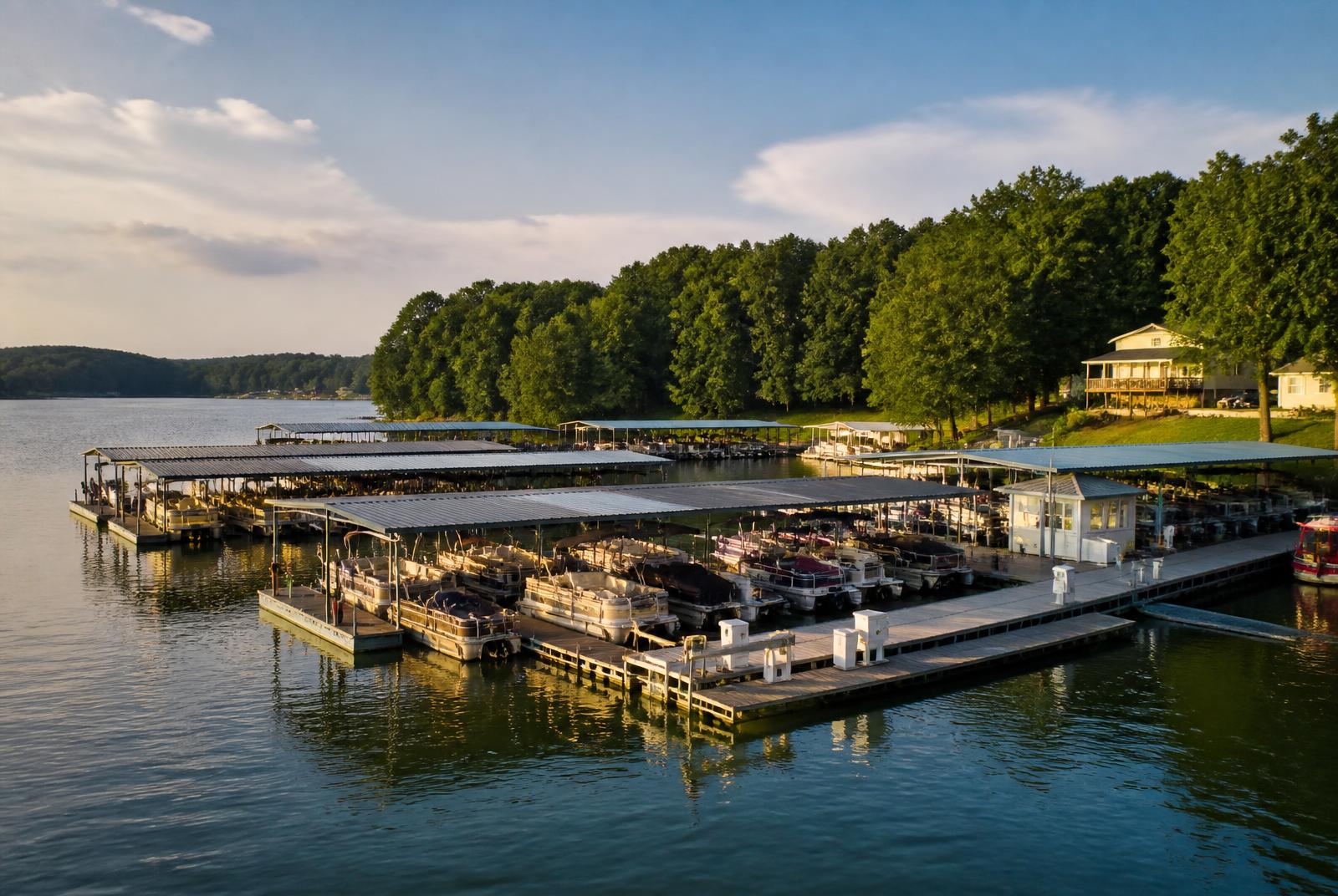
Lake Wylie is a 13,400-acre Duke Energy reservoir with roughly 325 miles of shoreline spread across York County, South Carolina and Mecklenburg and Gaston counties, North Carolina. Whether you rent for a weekend or keep a boat here year-round, this guide compares every practical option — rental fleets, marina amenities, storage formats, launch points, and the rules that govern all of it.
Renting versus keeping a boat on Lake Wylie
The first decision is not which boat, but whether to rent, slip, or dry-stack. Renting suits anyone on the lake fewer than a dozen days a year: no insurance, no winterization, no bottom paint, and no waitlist. A wet slip suits an owner who uses the boat weekly from April through October and values stepping aboard without waiting on a forklift. Dry-stack storage sits between the two — lower cost than a covered slip, far less hull maintenance, and a call-ahead launch window that works well on weekdays and poorly at 10 a.m. on the Saturday of a holiday weekend. Households shopping for a waterfront house often rent for a full season first, precisely because the rental year teaches them how much boat and how much dock they actually need.
- ◆Rent — fewer than roughly 12 outings a year, no ownership overhead
- ◆Wet slip — weekly summer use, instant access, highest seasonal cost
- ◆Covered slip — sun and hail protection, premium over open slips, waitlists common
- ◆Dry stack — mid-cost, minimal hull maintenance, call-ahead launch
- ◆Private dock — only where the Duke Energy shoreline permit allows it
- ◆Trailer and ramp — lowest cost, highest friction on summer weekends
Comparing the rental fleet
Rental inventory on Lake Wylie is overwhelmingly pontoon and tritoon, in the 20- to 26-foot range and seating eight to twelve. Pontoons are the default: stable, shaded under a bimini, forgiving to dock, and comfortable in a crowded weekend channel. Tritoons carry a third tube and a larger outboard, which matters on a July Saturday when the main channel builds a real chop and when you intend to pull a tube or a skier. Deck boats and bowriders trade shade for speed and suit smaller groups. Wake and surf boats are a specialty line with limited supply, premium pricing, and reservations that close out weeks ahead in peak season. Kayaks, canoes, and paddleboards are widely available and are the right choice for the creek arms above the main basin, where wake traffic thins to nothing.
- ◆Pontoon, 20–22 ft — the standard family day boat
- ◆Tritoon, 24–26 ft — faster, drier, better in weekend chop
- ◆Deck boat or bowrider — speed over shade, smaller parties
- ◆Wake and surf boats — limited fleet, book far ahead, premium rate
- ◆Personal watercraft — hourly rentals, restricted in some coves
- ◆Paddlecraft — creek arms, early mornings, protected water
What boating on Lake Wylie costs
Every figure here is directional and seasonal rather than a quote. Half-day pontoon rentals generally land in the low-to-mid hundreds, with a full day running roughly 40 to 60 percent above the half-day rate; tritoons carry a premium over comparable pontoons, and wake boats can run two to three times a standard pontoon. Fuel is billed on return rather than included, and a refundable damage hold is standard at pickup. On the ownership side, wet slips are quoted per foot per month or per season, covered slips carry a meaningful premium over open ones, and dry-stack pricing typically bundles a set number of launches. Add annual line items for insurance, registration in the state where the boat is principally used, winterization, and a service interval that marinas book out well in advance each spring.
- ◆Half day (about four hours) — the most common rental booking
- ◆Full day (eight hours) — better per-hour value, brutal in August heat
- ◆Fuel billed at return; refundable damage hold at pickup
- ◆Slips priced per foot; covered slips at a premium; waitlists are real
- ◆Dry stack often bundles launches into the monthly rate
- ◆Budget annually for insurance, registration, winterization, service
Marina amenities worth checking before you commit
Marinas on Lake Wylie range from full-service operations with fuel, pump-out, ship's store, service bays, and a restaurant, to quiet slip-only docks with a gate and a parking lot. Before signing anything, confirm five things: whether gas is sold on the water and during which months, whether pump-out is available on site, whether the marina has a service department or brokers work out, how the electrical and water service at the slip is metered, and what the gate and after-hours access policy is. Ask also about the waitlist mechanics — many Lake Wylie slips turn over slowly, and a spring inquiry frequently means a following-season start.
- ◆On-water fuel and its seasonal hours
- ◆Pump-out station and holding-tank policy
- ◆In-house service versus contracted mechanics
- ◆Slip power, water, and how each is metered
- ◆Gate hours, parking, trailer storage, and guest access
- ◆Waitlist position and realistic start date
Launching: ramps and access points
Public and marina ramps ring the lake on both shores. South Carolina access clusters around the Lake Wylie community, Buster Boyd, and the Tega Cay and Fort Mill approaches; North Carolina access sits nearer Belmont, Steele Creek, and the Mecklenburg parks. Which shore you launch from changes your day materially. A southern launch drops you close to the wide main channel and the big-water views; a northern launch is nearer the creek arms, the protected no-wake coves, and the shoreline restaurants that draw the boat-up crowd. On summer Saturdays, ramp parking at the popular access points fills by mid-morning, and the difference between an 8 a.m. and an 11 a.m. arrival is often an hour of queueing.
Rules, licensing, and safety on a two-state lake
Lake Wylie straddles a state line, and that has practical consequences. Both South Carolina and North Carolina require boater education for operators born after a statutory cutoff date, and rental operators verify eligibility at check-in; visitors can generally present an equivalent NASBLA-approved certificate. Life jackets are required for children under the state minimum while underway, navigation lights are required from sunset to sunrise, and impaired-operation standards mirror highway law. No-wake zones are enforced near docks, marinas, bridges, and swim areas, and the Duke Energy project boundary governs where you may tie up or build along the shoreline. Fishing licenses are state-specific, and reciprocity on this reservoir is a question worth confirming rather than assuming. Rules change: verify current requirements with the South Carolina Department of Natural Resources or the North Carolina Wildlife Resources Commission before you go out.
- ◆Boater education certificate for operators under the age cutoff
- ◆Life jackets for young children at all times underway
- ◆Idle or no-wake near docks, marinas, bridges, swim areas
- ◆Navigation lights sunset to sunrise
- ◆Duke Energy project boundary governs shoreline use
- ◆State-specific fishing licenses — confirm before casting
A season-by-season read on the water
Late April through early June is the finest stretch of the year: warm air, cool water, thin traffic outside Memorial Day weekend. July and August are the classic lake summer, with the warmest water and the heaviest weekend congestion, concentrated on Saturday afternoons and peaking over the Fourth of July. September and early October are the connoisseur's season — school is back, the channel empties, and water temperatures hold into the seventies. Winter boating is entirely workable on mild days, and Lake Wylie's modest winter drawdown keeps most docks and ramps usable year-round, which is not true of every reservoir in the Carolinas.
Using the water to evaluate a neighborhood
If you are shopping for a house, spend a day on the lake before you spend one with a floor plan. Run the main channel at midday, when the weekend chop is at its worst, and note which coves stay comfortable. Idle past the communities on your shortlist and read dock density, water depth at the shoreline, and how afternoon light lands on the back of each house — western exposure is a comfort question, not only a view question. Time the run from a candidate dock to the marina you would fuel at, and from that marina to the nearest boat-up restaurant. Shortlists reorder themselves quickly after a morning of this.