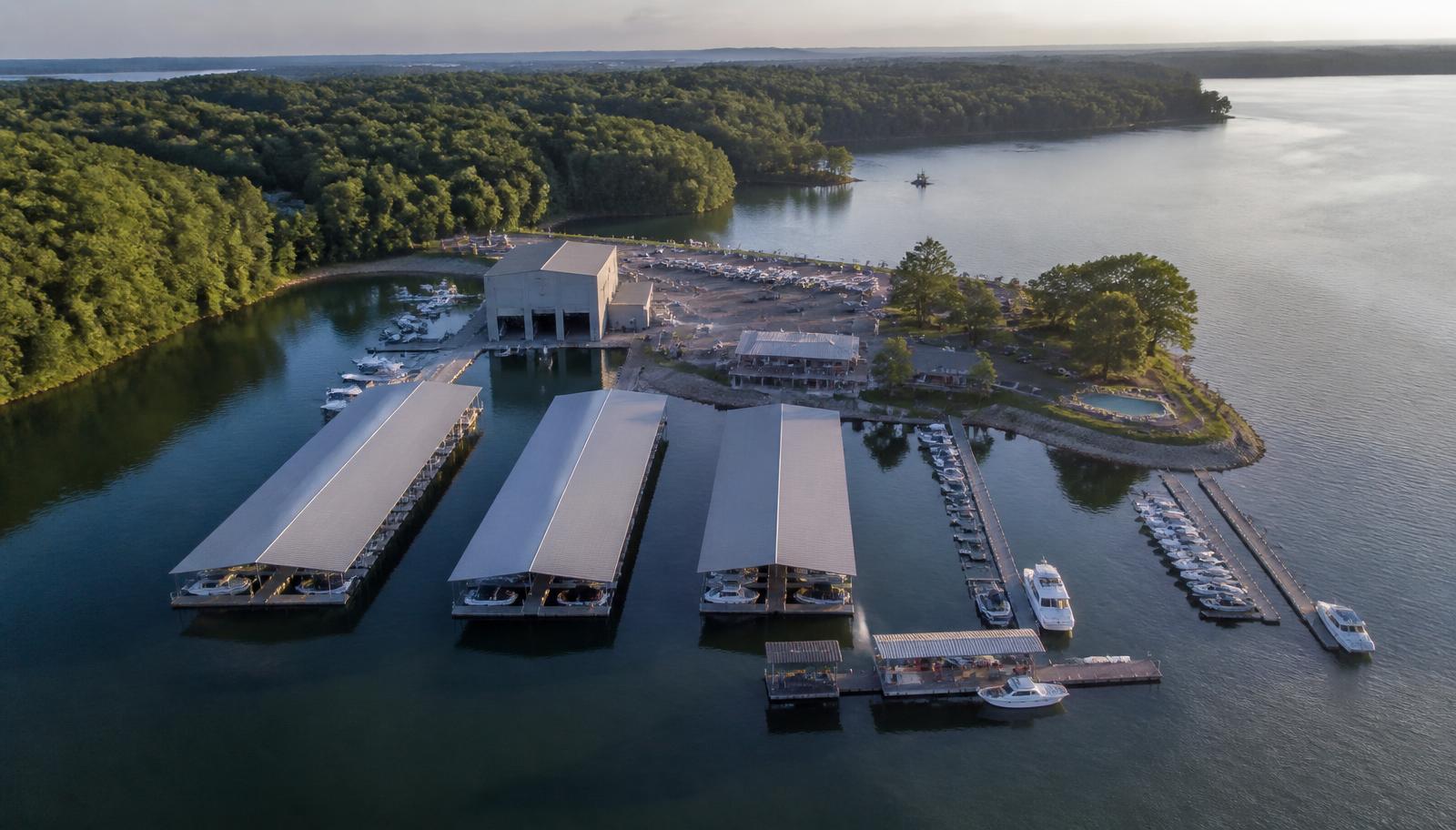
Lake Wylie Marinas: Slips, Fuel, Dry Storage & Service
On a reservoir where private dock permitting is finite, the marina is not a convenience — it is infrastructure. Where you keep a boat determines how often you actually use it, and on Lake Wylie that decision quietly shapes the real estate market too.
The four ways to keep a boat here
Owners on Lake Wylie store boats one of four ways: at a permitted private dock on their own shoreline, in a community slip held by an HOA or club, in a wet or covered slip leased from a commercial marina, or in dry-stack storage where the boat is racked indoors and launched by forklift on request. Each carries a different cost curve and a different friction cost. A private dock is the most valuable and the least available. Dry stack is the cheapest way to own a boat without owning shoreline, and it protects the hull and upholstery from sun and weather better than any open slip.
◆Private permitted dock — highest cost, highest convenience, finite supply
◆Community or club slip — allocated by HOA, often waitlisted
◆Open wet slip — lowest marina cost, most weather exposure
◆Covered wet slip — premium over open, materially better for finishes
◆Dry-stack rack storage — call-ahead launch, best hull protection
◆Trailer and off-site storage — cheapest, adds a ramp queue to every outing
What full-service marinas offer
The larger facilities ringing Lake Wylie combine slip leasing with the services that make ownership sustainable: gas and ethanol-free fuel at the dock, pump-out, ship's store, mechanical service and winterization, bottom cleaning, shrink wrap, and in several cases a restaurant or bar that becomes a destination in its own right. Smaller marinas and community docks may offer slips only, sending owners elsewhere for fuel and service. When comparing facilities, the questions that matter are fuel-dock hours in peak season, whether service is in-house or brokered out, and how the marina handles the winter drawdown.
◆Fuel dock — hours and ethanol-free availability
◆Pump-out station and waste handling
◆In-house mechanical service and winterization
◆Ship's store, ice, and last-mile supplies
◆Haul-out, bottom work and shrink wrap
◆On-site dining or a boat-up bar
◆Gated parking and after-hours access
Waitlists, leases and what they cost
Slip supply on Lake Wylie is tight in a way newcomers consistently underestimate. Prime covered slips at the most convenient marinas can carry multi-season waitlists, and community slips at gated communities are frequently allocated by tenure rather than purchase date. Leases are typically annual with a seasonal option, priced by slip length and coverage, and often carry an electric or utility surcharge. If you are buying a home and intend to keep a boat, get on a waitlist during due diligence rather than after closing — the wait is the constraint, not the money.
How marina access changes property value
Two otherwise comparable homes in the same neighborhood can diverge sharply in value based on water access. A permitted private dock with adequate depth is the largest single premium. Below that, a deeded community slip is worth substantially more than a rotating or waitlisted one, and a home a short idle from a full-service fuel dock is easier to own than one twenty minutes up a creek arm. Buyers looking at interior lots should price a marina slip into the annual carrying cost before comparing against waterfront inventory — it is often the rational move.
Duke Energy, water level and the shoreline
Duke Energy operates the Catawba–Wateree system and administers the Shoreline Management Plan that governs docks, piers, boat lifts, dredging, and vegetation within the project boundary. Marinas operate under that same framework, which is why slip configurations and expansions move slowly. Lake Wylie's operating band is narrow compared with mountain reservoirs, so seasonal drawdown rarely strands slips, but shallow coves and creek arms can become marginal in a dry autumn. Confirm depth at the specific slip or dock — not the marina average.
Choosing a home marina
Pick the marina you will actually drive to. The most common ownership failure on any lake is a slip that is technically cheaper and practically inconvenient: the boat goes unused, the fees continue, and the household concludes lake life was overrated. Weigh drive time from the house, the fuel dock's summer hours, whether service is in-house, and how crowded the launch and channel are on a Saturday at two in the afternoon. Then visit once on a weekday morning and once on a peak weekend before you sign.
Frequently Asked
Questions
How many marinas are on Lake Wylie?
The lake is served by a mix of full-service commercial marinas, community and club docks, and public access points on both the North and South Carolina shores. Full-service facilities — those with fuel, service, and slip leasing — are a small subset, which is why slip demand consistently outpaces supply.
What does a boat slip cost on Lake Wylie?
Slip pricing varies by length, coverage, and facility, and is usually leased annually with utility surcharges. Covered slips command a clear premium over open slips, and dry-stack storage is generally the least expensive way to keep a powerboat without owning shoreline. Confirm current rates directly with each marina.
Is there a waitlist for boat slips?
Frequently, yes — particularly for covered slips at convenient facilities and for deeded slips inside gated communities. Anyone buying a home with a boat should join a waitlist during the due-diligence period rather than after closing.
Can I build a private dock instead?
Only if the parcel's Duke Energy shoreline classification, water depth, cove width, and neighbor setbacks allow it, and only with a permit. An existing permitted dock is materially more valuable than the theoretical right to apply for one.
Where can you buy fuel on the water?
Several of the full-service marinas maintain fuel docks with seasonal hours, and a few offer ethanol-free gas. Off-season hours contract sharply, so confirm before planning a long winter run.
Watch
Lake Wylie Marinas — Video Guide
Aerial and dock-level footage of the lake's full-service marinas, covered slips, fuel docks and yacht club basins across both Carolina shorelines.